
What Bali Does to You
Séverine Parvati Buyse
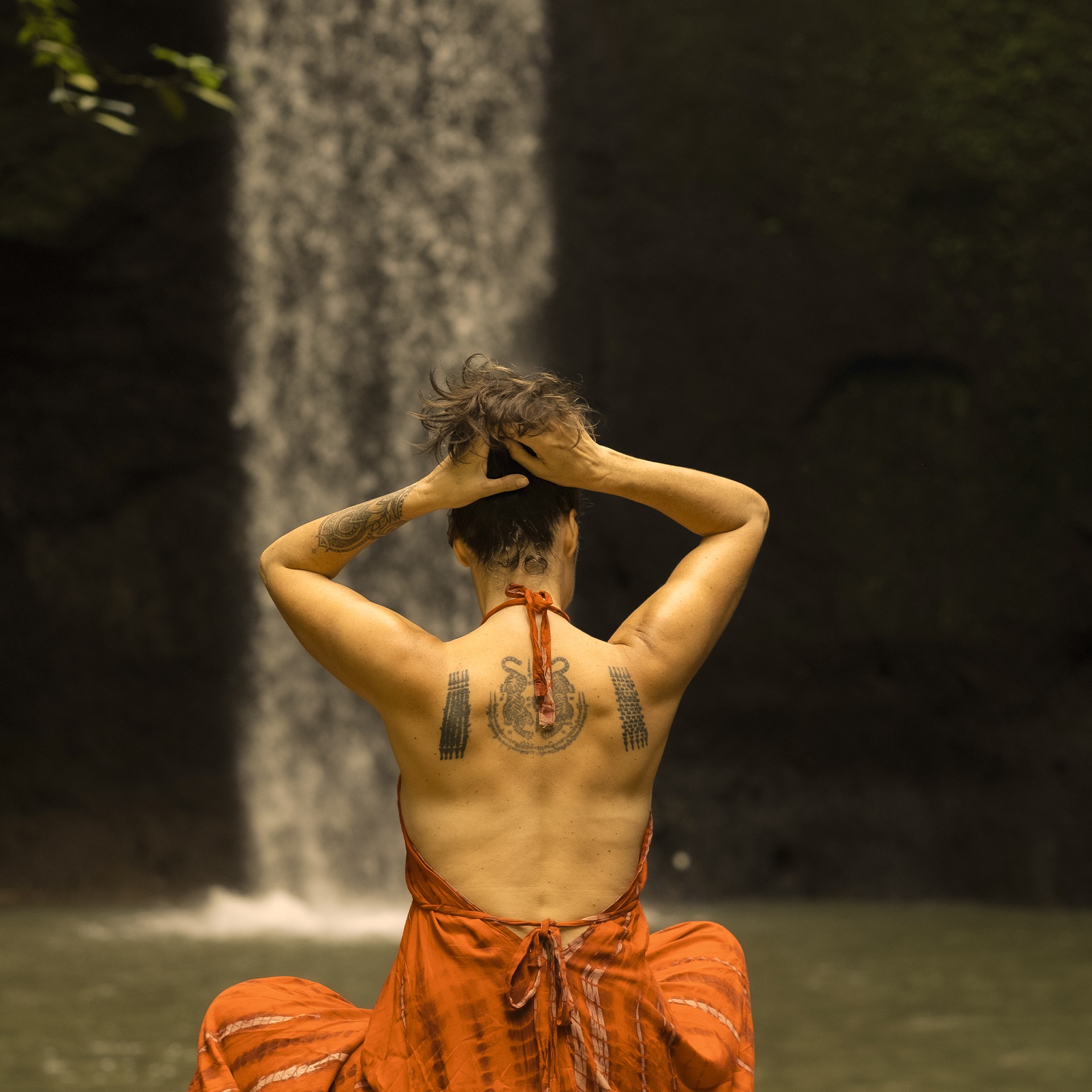
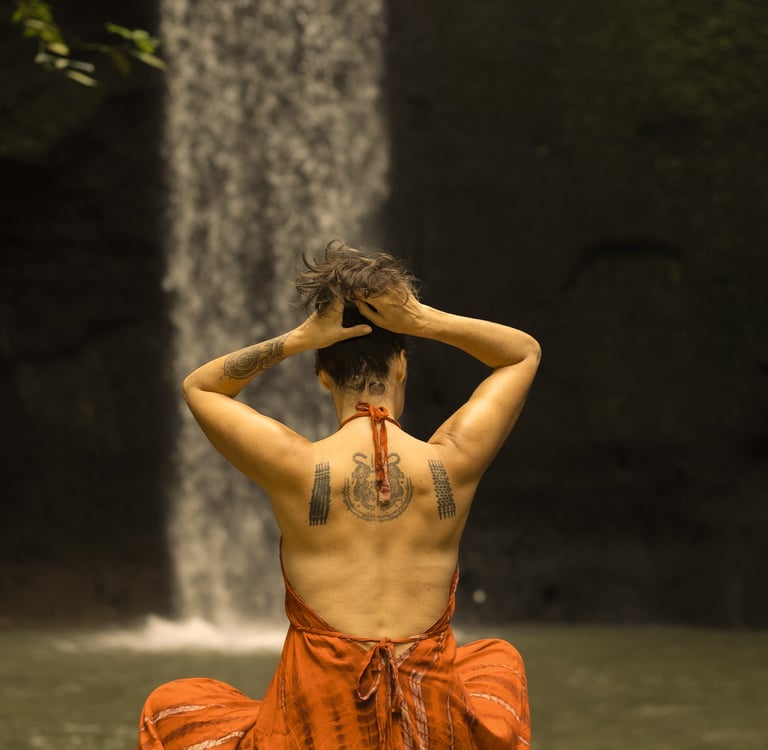
It is barely 7am in Ubud, and I am sitting quietly facing the jungle. The green is impossible — lush, dense, overflowing with life. Warm air settles onto the skin without asking permission, familiar and ancient, as though the body has always belonged to this climate. The wind moves gently through my hair while scooters hum somewhere in the distance, blending into the rhythm of the morning. Beside me sits a pressed coffee, dark and rich, while two monkeys move across the trees nearby — the larger one first, then an older female with one eye half-closed. Slow. Precise. Entirely unhurried.
A few moments later, the Balinese owner steps outside carrying a small basket of offerings filled with water, incense, and grains of rice. Quietly, almost invisibly, he blesses the ground, the air, the unseen world around him. It is a ritual so woven into daily life that it happens before breakfast, before work, before anything is demanded of the day. Nothing dramatic. Nothing performed. Just devotion moving through ordinary life.
People often ask me why I keep returning to Bali after fifteen years. The truth is complicated because yes, the island has changed. Rice fields have disappeared beneath luxury villas and swimming pools. Healers now charge by the hour. Influencers record themselves searching for meaning before they have even fully felt it. Tourism has reshaped the landscape in visible and painful ways.
And still, something essential remains untouched.
The energy of this place continues to move through the body in ways that are difficult to explain logically. The heat arrives first, softening something internal. Shoulders relax. The jaw loosens. Even the hair becomes impossible to fully manage, and somehow that feels symbolic — the first surrender. Music drifts through the streets constantly, not as entertainment but as atmosphere. Smiles land directly in the chest before the mind has time to analyse them.
Inside the café, the waiters laugh together in the background. Not competing. Not performing. Simply existing beside one another. Connection here feels more important than achievement. Work is only the container through which life moves.
There is also a quiet dignity in how people carry themselves. Modesty exists naturally. The body is present but never treated as the entire identity. A little lipstick, simple clothing, flowers tucked behind the ear — beauty appears as something sacred rather than something to display.
And then there is the coconut, almost absurd in its simplicity. Tired? Coconut. Dehydrated? Coconut. Hair damaged? Coconut. Stomach uneasy? Coconut. One fruit carrying an entire philosophy of care — something grown freely from the earth, asking for nothing while giving everything.
What makes Bali different is not simply the landscape. It is the rhythm of life itself. Ceremonies and rituals shape the days in ways many Western minds struggle to fully understand. Life moves with the moon, with devotion, with community. More than half of existence is dedicated to tending the invisible world — not as a wellness trend, but as the structure of reality itself.
Before work.
Before urgency.
Before productivity.
This is not laziness or avoidance. This is reverence.
And perhaps that reverence holds the nervous system in ways modern systems never can.
Community here also changes everything. People share constantly. They gather, speak, help, and hold one another in daily life, not only in moments of crisis. The loneliness that silently empties so many Western lives has far less room to grow here because connection remains part of the architecture of existence.
Beauty, too, is treated differently. It is not decoration. It is devotion made visible. An offering made carefully by hand. A flower resting behind the ear. Incense wrapped in leaves that will eventually return to the river. Nothing forced to last forever. Nothing disconnected from nature.
Everything feels alive.
Everything belongs somewhere.
Everything remains in conversation with everything else.
To live inside that rhythm, even briefly, is to feel the body remember something ancient — something it forgot it knew.
But Bali is not only light.
The women here work endlessly, many carrying exhaustion in their bodies before the age of thirty-five. The land suffers under concrete and tourism. Rivers carry plastic and waste left behind by visitors who came searching for healing without understanding responsibility. And there is another darkness too — the invisible one people rarely speak about openly.
Bali understands the unseen world deeply, both its healing and its danger. Ritual here is not only celebration; it is protection. A constant tending of boundaries between what is visible and what is hidden.
That honesty is part of what makes Bali powerful. It does not pretend life is only beautiful.
And still, despite everything, Bali continues to hold people gently.
The shifts that happen here are real. They happen in the nervous system, in the body, in the quiet parts of a person that had stopped believing they could still be reached. Time feels softer here. Tears arrive unexpectedly. Encounters feel meaningful without explanation.
Not because Bali adds something new to you.
But because it helps you remember something you already carried.
Perhaps that is what we are truly missing in modern life. Somewhere along the way, we outsourced aliveness itself — to schedules, to screens, to endless performance. Bali reminds us that we need beauty, ritual, community, and connection far more than we allow ourselves to admit.
This is not spirituality as performance.
This is life remembered.
And you do not need to travel to Bali to experience it.
You only need to remember what your body already knows: that aliveness is not something given to you from outside. It is something you return to.
Bali does not heal people because it is exotic. It heals because there is truth embedded in the way life moves there. A slower truth. A more connected truth. A truth your body recognises immediately.
A way of living where flowers belong in the hair, where laughter belongs beside the rain, and where being alive matters more than constantly doing.
If something inside you recognises this feeling, then perhaps the journey was never really about Bali at all.
Perhaps it was always about returning to yourself.
Séverine B.
April 19, 2026